
We grab some sweet water from the well and note the food drop left for Paul Davies, A cyclist from Tassie heading North from Wiluna.

There are 3 cyclists we are aware of. Paul from Tassie heading North, Martin Adersballe, a Dane heading South and some nutter on a home made bike, made from Bamboo....we are ready to hit the road @ 0800. Probably about time I opened up a little about these trip names. The idea came from Brenda. She chose Snoozy for herself, due to her uncanny nack of having little snoozes in the car, usually in the most roughest of locations. For Steve and myself, you will have to wait a bit longer. In all honesty, I cant remember the names she picked for Peter and Willie, but I chose Harry and Wilma. Which is probably a bit unfair on Willie, cause it has no relationship whatsoever, apart from her husbands knack of not getting names straight. In the morning, I would wake and great Peter with a g'day. He would reply back to me G'day Steve. So I would reply how's it going Harry. He would reply alright George. A bit of a laugh, I'm sure if we spent more time than 3 weeks together, he would eventually get that I wasn't bloody Steve! Morning noon and night, the Harry and George game played on.
My recollection of Brenda's names was not quite correct. Brenda corrects these in the comments section where she says:
These were the nicknames I endowed everyone with.
Your fine self was Captain Flatulent, Steve was Mr Mankini, Willie was Mrs DamperMaker, Pete was King Campfire & I was Ms Snoozalot
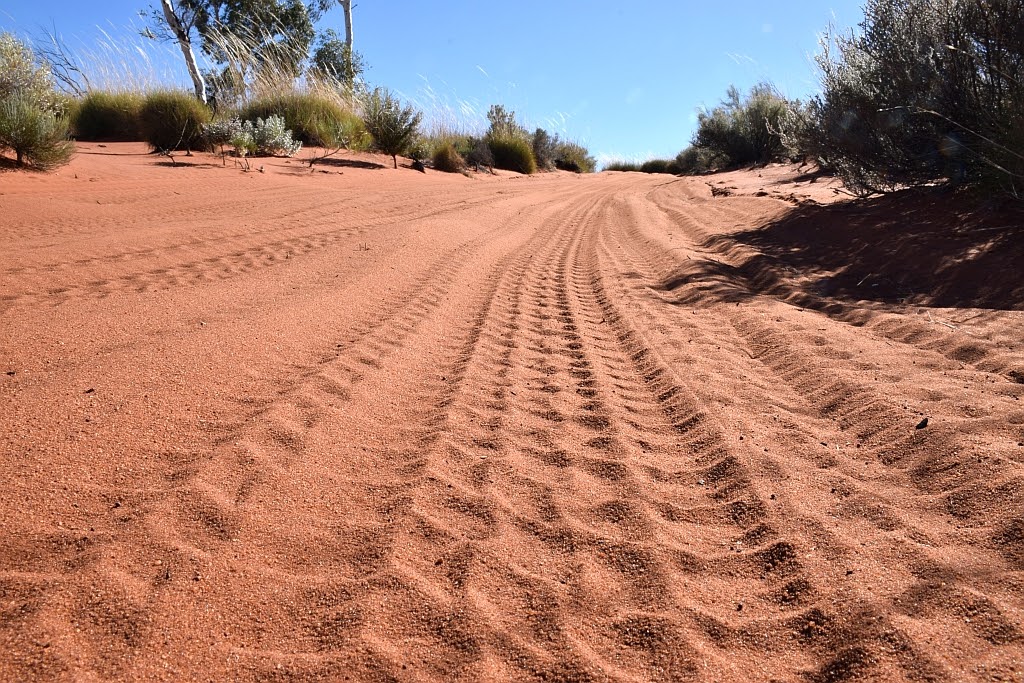
We are now well into dune country. They were great to drive through. Unfortunately, there was very little run up, and some were quite wallowed, but apart from a couple of attempts at some for all of us, it proved no drama. Over the Dune and you would run parallel to the next dune for ages. Which in itself, wasn't a bad proposition, because the country was just gorgeous. The deep red sand contrasting remarkably against the green vegetation. I note the difference between here and the Simmo. The vegetation here is much vaster, lots of big gums around too. The problem with traversing the swales for long periods, was that they too were corrugated quite a bit. It was a real pleasure to start climbing a dune and not have to shake, rattle and roll.

We spot our first camels for the trip:

and push on for well 45. We pass another wreck and note the intensity of the fire. Melted alloy components such as gear boxes, wheels etc:


Well 45 is nothing of interest, but more rusted parts of yesteryear. We move onto Gravity Lake, where I pick up my first of 4 planned Canning Caches:


Well 44 another ho-hum affair. More dunes towards 43:

12 Km's from well 43, we finally meet Martin, the Danish cyclist:

Its about 1230, temps in the mid 30's and Martin is looking tired. We are nearly 400Km's South of Bililuna so I'm not surprised. He has had some tough going, these dunes are testing his endurance. He can ride down the dunes, but has to push his bike up them and also in the softer sandy sections of swales. We offer food and water, but he declines. His mission is to do the trek unassisted if he can. He has plenty of food, 14L of water and another 100Km's to go to well 38, the next source of good water.
So we get to a junction by well 43. Not sure which track is the well, I take the right. It was the wrong choice. I radio the others and they take left while I find a spot where I can turn around. The others have the bejesus frightened out of them when the wild man of Borneo pokes his head out the bush, waving his arms above his head. We have met Paul, the second cyclist. He was a bit spooked himself, he saw a white car drive off into the distance, thinking to himself...Nooooooo, they are not coming into the well, where he was parked up:

Paul was doing it tough. He had been on the CSR for 2 months now, since he left Wiluna. He had 5 days worth of food and no water. Well he had liquid. Something he scooped up from well 42. He pulls 2 x 2L fruit juice bottles out and said, I was about to have to drink this. The bottles contained a liquid that looked like Ribena. He cracked the lid. I was 20M away and was almost heaving at the stench. It was a putrid juice of bad water, camel poo, dead finches and bacteria any research scientist would kill for. In fact, I reckon had he been forced to consume it, it would have killed him too.
He greatly accepted as much water as he could take. Mind you, he really needed new water bottles too, cause rinse all we like, that stench had permeated those bottles and would be fouling his nice clean water we gave him. He also greatly accepted our food offerings, some fresh, some we were to burn that night at camp. We reckon the mouldy green corn cobs we gave him were being chomped on, raw, as soon as we left his company. And maybe even the leaves wrapping the cob too.
I suggested he stay put, Martin would make his acquaintance in a few hours. But he had to push on. He also had 100Km's to good water at well 46. No doubt Martin and Paul had a great night somewhere in the spinifex encrusted dune country where they were about to meet.
EDIT: 28/08/16 - source: Facebook
Danish CSR cyclist, Martin Adserballe made it to Wiluna on Wednesday 24 August 2016 (he left Billiluna on 18 July - thus taking 39 days)
Tasmanian cyclist Paul Davis arrived earlier in the month on 5 August, but I'm not sure when he left Wiluna.
Well 42 was a dust bowl and a pissant little soak, full of that camel poo, dead finches and bacteria. Here is where he took his last water:

We pull up stumps at 1600 in a cleared section of swale, the 2 opposing dunes quite a short distance apart. Harry finds some more dead tree's and we have a good night again by the fire. Another 150Km's of CSR done:

Day 10. More Great Sandy Desert. I'm loving this country except for all the bloody corrugations:
We seem to be in the swing of things now. On the road by 0800, finished by 1600 and covering about 150Km's a day. Today, is no different. Onto well 41, another dust bowl with relics of an era long past representing a well. But 41 had water at least. I decided to transfer some fuel from the auxiliary and found I had no power to do so. Investigating the issue, I found I had blown a fuse. I have no idea why, as it hadn't been used, and after replacing it, it hasn't happened again. So a quick easy fix.
The scenery out here is just stunningly beautiful. We constantly remark about it on the radio. The contrast between the red desert sands of the dunes and the very green vegetation has to be experienced in person to believe:


But take note fellow traveler. This is a nasty landscape and its a fine line between an enjoyable experience and a nightmare. On the way into well 40, a 3km track through a lovely set of dunes, we spot another group of camels living the life of riley:

The well itself, nothing to write home about, but nearby, some history is evident. The grave of Michael Tobin, speared by natives. If you had to pick a resting place, this would do me just fine:

A balanced account of this comes from the National Museum:
During Canning's return to Wiluna in 1907, a member of his party, Michael Tobin, was fatally speared at Natawalu (Well 40). In the same moment Tobin shot and killed Mungkututu, the Aboriginal man who had speared him. To this day, the reasons given for this incident are varied. One account says that Tobin had taken Mungkututu's wife, while another says that it was revenge for the theft of sacred objects by Canning's men. Mungkututu may have been frightened by Tobin, afraid of being chained up, or angered by the uninvited intrusion of strangers at his waterhole. Whatever the cause, in both Aboriginal and non-Aboriginal histories, the incident has come to symbolise the clash of cultures that defined the early days of the Canning Stock Route.
Times were tough back then for sure. Nearby we also spot a conspicuous site in the sand. The origin and reasoning of which, to me is unknown:

(EDIT: I am led to believe this a monument to Mungkututu, his body buried some considerable distance away - credit to Peter Gargano)
And tracks in the sand. Yet another camel toe:

and what we believe to be a bush bustard:

Onto well 39 and we cross Tobin's lake, named in honour of Michael Tobin. Here we hit the flats and I reach my highest recorded speed for the CSR, a whopping 75KM/h. A wild dog, cross dingo, spotted slinking away in the bush. A mangy looking thing, the things required to sustain life, IE food and water, must be very hard to come by out here. Certainly a meagre existence to be had:


The plan was to camp at well 38, a known source of good water. Well 39 was another insignificant little soak, much like 41, so we are on the track again after a spot of lunch. More dunes to traverse, today not being my day. Steve was in his element though:

We take the opportunity to will up our water bags once again:

Its quite warm, a wind is blowing and the ground very rocky and exposed with no shade, so we decide to push on for a more suitable camp. A wiser decision one could not make. We haven't seen a desert oak for days now, but just prior to well 37, around 1630, we find the most spectacular grove of desert oak and a good clearing for a camp. This place was just bliss:

A fine specimen of oak, sitting just to the East of Camp:

I spy a suitable old tree 500m from Camp and "Harry" and Steve get to work. When it hits the ground, I'm sure it registered on all the seismic recorders around the country. Peter returns with the spoil of his labours and complains once again about our bloody hard wood, full of sand, and requiring the chainsaw to be sharpened once again.

But the fire was great:

During the day, one of Peter's gas bottles had became unsecured and took the handle off the kettle. The next morning, being the bush mechanic he is, it was sorted with some fencing wire and a couple of Tek screws:

Constable Thompson became one of the first drovers to travel down the route in 1911. He and his droving companions, George Shoesmith and ‘Chinaman’, were killed by Aboriginal people at Well 37. The route was scarcely used again for twenty years.

Back at the well, we find 2 old rusty signs. Hard to read the first states T+S graves 118 yards. The other seems to say Mclernon's grave 60 yards. The sign, just propped in a log, could have been moved dozens of times so we dont really know the direction. We scout a wide area looking for evidence of another grave, but come up empty handed.
Drovers referred to Lipuru as the ‘haunted well’. The graves of nine people, all victims of violent death, are said to lie near Well 37. Drovers George Shoesmith, James Thompson and ‘Chinaman’ were killed at Lipuru by desert people in 1911. Their bodies were found by Thomas Cole, the next drover down the route. It was later rumoured in Perth that Cole took his revenge on an Aboriginal family near Lipuru. Martu accounts support this. Two Aboriginal men and a woman and two children who were shot by white men are said to be buried on the other side of Well 37.
In 1922, three members of the Locke Oil survey expedition, John McLernon, Leo Jones and William Turner were camped at a site about two days south of Lipuru when they were attacked in their sleep by three Aboriginal men. McLernon received a fatal blow to the head. Turner woke to see a man standing above Jones ready to club him and called out in warning but realised that he was about to be clubbed too. Both sustained blows to the head, but their attackers scattered and fled when Turner began firing shots. The next day the two men transported McLernon’s body by camel to Lipuru where he was buried.

I have found an excellent source of reference on the CSR as listed below:
http://mira.canningstockrouteproject.com/
On the road again and we find more evidence of vehicles that never made it:

Well 36 seemed to have some reasonable water, well 35 is just a bore casing and well 34, very similar to the rank little soak at 42. However we had been warned from the start that wells 34-31 were the worst conditions on the track. Around Breaden Hills I was saying that I doubt they could get much worse, but I was wrong. Even at 20Km/h, the literal shit was shaken out of everything:

Unfortunately, just short of well 33, one of my shocks gave up the ghost too:

Righto. So I need to put some perspective into this. Conditions were severe. I was near 400Kg over GVM. Tyre pressures were down to about 20psi hot, trying to balance comfort against the risk of staking. I was probably pushing a bit hard at the start, but adjusted speed accordingly once I knew the situation. A temp measurement showed the shock at 105 degrees, much cooler, by up to 80-100 degrees than 2 competitor's shocks. So they were doing the business well. I had made 800Km's of CSR by now. One of the competitor shocks lasted 100Km's. Everyone we spoke to was having suspension issues, and lots of people had to bail out for new shocks. So I was not alone in that regard.
I have been in contact with the manufacturer and they have never seen this happen in their product yet. So I still hold faith in the product. I will work with the manufacturer to sort this engineering issue out and we will all end up with a superior product, one that can handle the rigor's of probably the worst piece of road in the country one could travel. Watch this space.
So into well 33 I limped, to replace the shock. Unfortunately I didn't get to see or enjoy much of that well as we arrived at 1615 and t it was a mad scramble to replace the shock before dark.
(credit to Mrs Snoozalot for the following picture)


And so ended day 11, a hard, 100km day.
Well 46-37:
Well 37- 33:


